Next to The Florida Mall in Orlando
407-747-3124
Facial Specialist vs Nail Specialist License in Florida
2026-09-28
TL;DR: Florida's facial specialist license and nail specialist license are two completely separate credentials issued by the Florida DBPR (Department of Business and Professional Regulation). They cover different services, require different training hours, and carry different restrictions on where you can legally work. Picking the wrong program for what you actually want to do is one of the most avoidable mistakes a beauty student makes.
A lot of people assume these two licenses are basically the same thing, just for different body parts. They're not. The scope of practice and the training path look pretty different once you lay them side by side—and the licensing agency, along with the long-term career options, differ just as sharply.
If you're deciding between a skin-focused career and a nail-focused one, or you already hold one license and you're thinking about adding the other, this breakdown is worth reading before you commit to anything.
What Each License Actually Covers
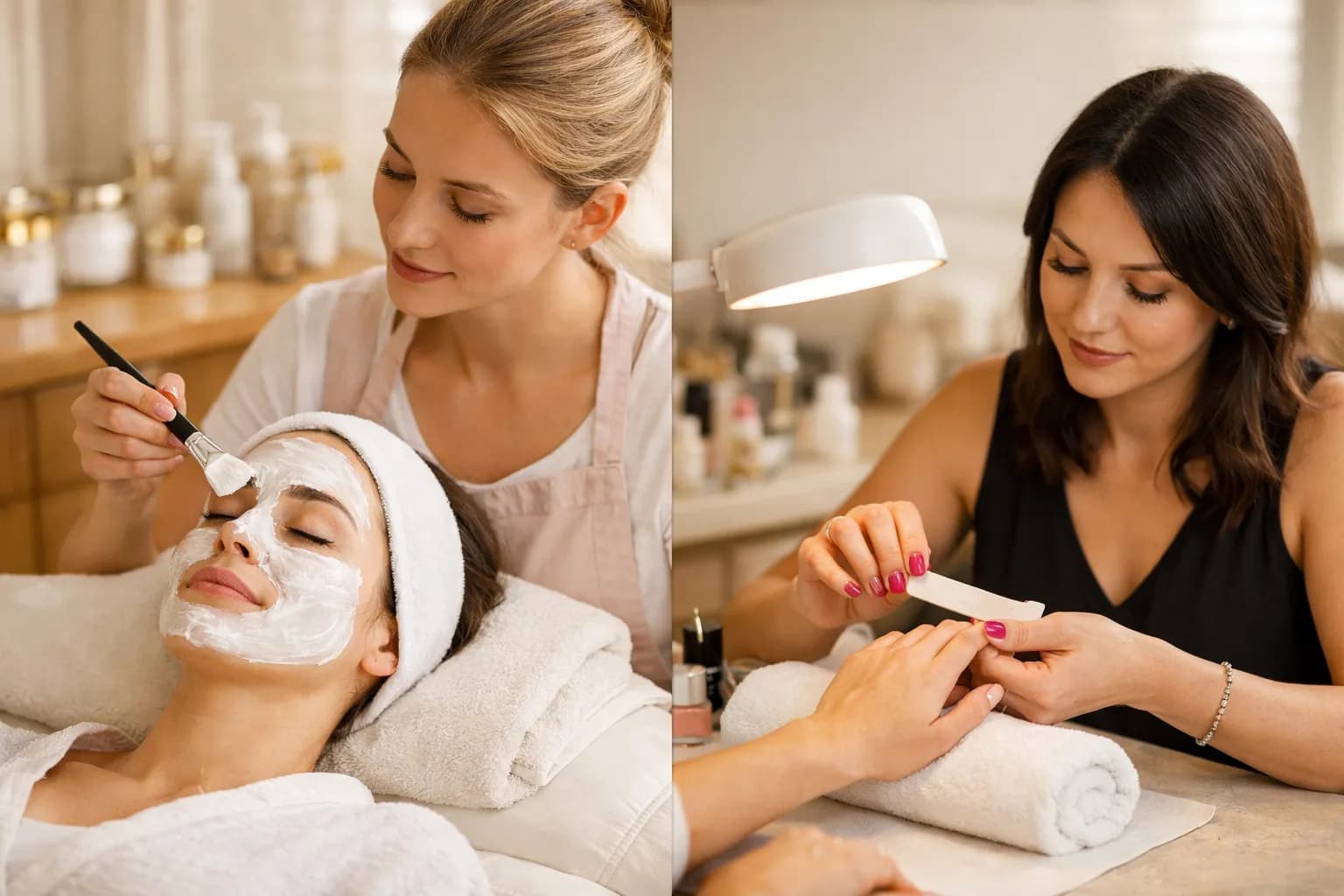
Florida's facial specialist license (sometimes called an esthetics or facial specialist license) authorizes you to provide services to the skin of the face, neck, and décolletage. That includes cleansing, exfoliation, extractions, facial massage, masks, and the application of skincare products. It does not cover the full body, it does not authorize you to perform chemical peels above a certain depth, and it does not overlap with anything in the nail space.
The nail specialist license covers the care and beautification of fingernails and toenails. That means manicures and pedicures, nail enhancements like acrylics and gels, and nail art — along with the tools and sanitation practices that go with all of it. Nail specialists are not authorized to perform skin treatments on the face.
Those boundaries matter for two reasons: your liability and your ability to work legally. Doing services outside your licensed scope isn't a technicality. It's a violation that can put your license at risk.
Training Hours and How You Get There
This is where the two paths start to look pretty different.
The facial specialist program is a 220-hour, state-approved curriculum. At Pristine Beauty Academy, that works out to roughly two and a half months of training. The curriculum covers skin anatomy, skin analysis, contraindications, facial techniques, product chemistry, and sanitation.
The nail specialist program runs shorter. The state-approved hours are fewer, and the program is designed to get you competent and licensed in about two months.
Both programs complete all required testing at the academy, so you are not going off-site to sit an external state exam for either of these licenses. After you finish, you apply to the Florida DBPR (Department of Business and Professional Regulation) for your credential. The DBPR issues the license; the academy gets you ready for it.
For a full picture of what each program requires and what the Florida licensing process looks like, the licensing page at Pristine Beauty Academy walks through the details by program.
Where You Can Work (and Where You Can't)
Both licenses require you to work inside a licensed Florida salon or spa. Neither one authorizes you to perform services in an unlicensed space, which includes your home unless your home has been inspected and licensed as a salon facility by the state. That's a harder process than most people expect, and it applies equally to facial specialists and nail specialists.
Beyond that shared rule, the two licenses open up different environments.
Facial specialists most often work in:
- Day spas and medical spas (though the med-spa side involves additional supervision requirements)
- Esthetics studios and skin-focused boutiques
- Resort and hotel spa settings
- Dermatology offices (in a support capacity, not a clinical one)
Nail specialists most often work in:
- Nail salons and full-service salons
- Day spas with nail departments
- Booth-rent setups inside larger salons
- Private suite rentals
Booth rent is a particularly common path for nail specialists early in a career. You pay a flat weekly or monthly fee for your space and chair, then keep every dollar your clients bring in—running the whole operation as your own small business. What Florida nail techs need to know about booth rent is worth reading if that path is on your radar.
License Renewal and Continuing Education
Both licenses renew every two years, and both have the same renewal deadline: October 31 of every even-numbered year.
Facial specialists must complete 16 hours of approved continuing education before each renewal. Four of those hours must be in HIV/AIDS and communicable disease topics; the remaining hours can come from a range of approved subjects, including advanced skincare techniques and product knowledge, as well as sanitation updates.
Nail specialists have the same two-year renewal cycle with their own continuing education requirements. The specifics mirror the esthetics renewal in structure, though the approved subject matter naturally tilts toward nail-specific content.
Missing your renewal window doesn't just mean a fine. A lapsed license means you legally cannot perform services until it's reinstated. Set a calendar reminder now, regardless of which credential you hold.
Can You Hold Both Licenses at Once?
Yes. Nothing in Florida law prevents you from holding a facial specialist license and a nail specialist license at the same time. Some professionals train in one specialty first and get established before adding the second credential when they're ready to expand what they offer or open a studio that covers both.
If you already hold one and want to add the other, you'd complete the additional program and apply separately to the DBPR for the second license. The two credentials are independent of each other; one does not substitute for or accelerate the other.
This is also worth thinking about if you're planning to open your own studio eventually. A space that can offer both facials and nail services has a broader client base than one that only does one or the other. The Own It guides at /own-it cover the business setup side of both specialty paths, including what it looks like to run a dual-service studio.
Choosing Based on the Work Itself
The licensing mechanics are just logistics. The more important question is what you actually want to do with your hands and your days.
Facial specialists spend most of their time reading skin and customizing treatments, building long-term client relationships around a skincare routine. The work is slower-paced per appointment and deeply consultative. If you're drawn to skin health and product science—and you want to watch a client's skin transform over months—that's your lane. The skin health trends shaping 2026 give a good sense of what clients are asking for right now.
Nail specialists tend to book more appointments per day, and the creative range is wide. Nail art and specialty gel work attract clients who want something specific and visual, while nail enhancements draw those looking for lasting structural results. If you like precision and a fast-moving schedule—and creativity is central to how you work—the nail path tends to suit that energy well. What's driving nail tech demand in Central Florida is a solid read if you're weighing whether the market supports the career you're picturing.
Neither license is harder than the other. They're just different. Knowing which one fits your actual career goals before you enroll saves you time and money—and spares you a lot of frustration.
FAQ
Q: Do I need a cosmetology license to do facials or nails in Florida? A: No. Florida issues separate specialist licenses for both facial services and nail services. You do not need a cosmetology license for either. The facial specialist license is issued by the Florida DBPR (Department of Business and Professional Regulation), as is the nail specialist license.
Q: Can a nail specialist do facial services with a Florida nail license? A: No. A Florida nail specialist license only authorizes nail services. Performing facial treatments without a facial specialist license would be practicing outside your licensed scope, which is a violation under Florida law.
Q: How long does it take to get a facial specialist or nail specialist license in Florida? A: The facial specialist program is 220 state-approved hours, which takes about two and a half months. The nail specialist program is shorter and runs about two months. After completing the program and required testing at the academy, you apply to the Florida DBPR for your license.
Q: If I already have a nail specialist license, can I add a facial specialist license later? A: Yes. The two licenses are completely independent. You'd complete the facial specialist program and finish the required assessments, then apply to the Florida DBPR for the second credential. Neither license substitutes for the other, and holding one does not shorten the training required for the other.