Next to The Florida Mall in Orlando
407-747-3124
Dermaplaning Basics Every New Facial Specialist Needs
TL;DR: Dermaplaning is a manual exfoliation technique that uses a sterile surgical blade to remove dead skin cells and vellus hair from the face. In Florida, it falls under the facial specialist scope of practice, so your state-issued facial license is what you need. The skill is learnable, but good results come from understanding skin, angle, and tension together.
If you are drawn to skincare work, dermaplaning is probably one of the first services you have heard clients talk about. It has a loyal following, it photographs beautifully on social media, and clients come back for it regularly. That combination makes it one of the more sought-after skills a facial specialist can add to their menu early on.
But social media gives you the glow-up without the context. What is the blade actually doing? Who is a good candidate and who is not? What could go wrong if the technique is off? Those are the questions worth answering before you are standing behind a treatment bed with a blade in your hand.
What Dermaplaning Is Actually Doing to the Skin
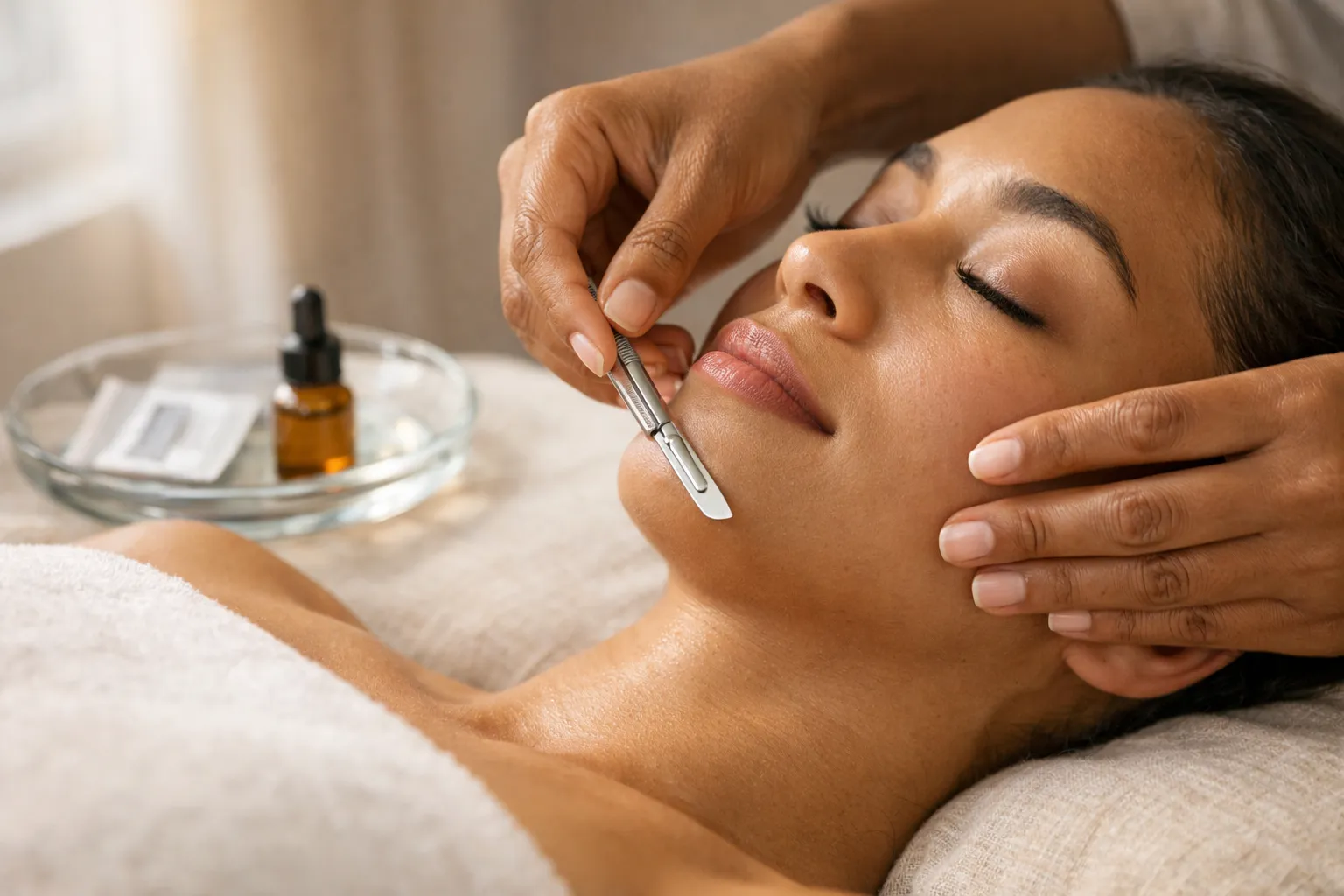
Dermaplaning works at the surface of the skin. Using a sterile, single-use surgical-grade blade held at a 45-degree angle, you make short, feathering strokes across taut skin to lift away the top layer of dead corneum cells along with the fine vellus hair (commonly called peach fuzz) sitting on the surface.
The result is immediate. Skin looks smoother and brighter because you have cleared the layer that scatters light unevenly, and tone becomes more even as a result. Makeup sits differently. Skincare products absorb faster because there is less physical barrier slowing them down.
This is not a deep chemical peel or a laser treatment. The benefits are real, but they are surface-level by design. That is also what keeps the service within the scope of a licensed facial specialist rather than a medical provider.
Florida License Requirements for Dermaplaning
This is the question that trips up a lot of people looking into skincare services: which license actually covers it?
In Florida, dermaplaning is considered an esthetics service. A licensed facial specialist can perform it. You do not need a separate medical credential, a physician's supervision arrangement, or any other license on top of your facial specialist license to offer it in a spa or salon setting.
The Florida facial specialist program at Pristine Beauty Academy covers skin analysis and contraindications within the state-approved 220 hours, while hands-on facial techniques are woven throughout the curriculum. That foundation is exactly what dermaplaning builds on, because understanding how to read skin before you pick up a tool is not optional.
Graduates apply to the Florida DBPR (Department of Business and Professional Regulation) for their license after completing all required testing at the academy. No external state board exam is required. Once you are licensed, dermaplaning is in your scope.
Skin Analysis Before You Ever Pick Up the Blade
This is where new specialists get into trouble: rushing past the consultation to get to the technique. Dermaplaning is not appropriate for every client, and knowing who to redirect is as important as knowing how to perform the service.
Skin conditions that are contraindications for dermaplaning include:
- Active acne breakouts or open lesions anywhere in the treatment area
- Rosacea with active flushing or visible broken capillaries in the zone you would be treating
- Sunburned, windburned, or otherwise compromised skin
- Current use of isotretinoin (commonly known as Accutane) or recent use within the past six to twelve months, depending on the guidance your post-training education provides
Clients who have seborrheic dermatitis or any active skin infection are also not good candidates on that visit.
The clients dermaplaning works best for are those with dry or dull skin, uneven texture, fine lines related to dehydration, and anyone who wants their makeup or serums to perform better. It is a genuinely crowd-pleasing service when the client is a good match.
Before every session, you are also asking about recent sun exposure, any new skincare products in their routine, and any other treatments they have had recently. Chemical peels and dermaplaning on the same skin, in the same week, is too much exfoliation.
For a full breakdown of why the pre-service conversation matters for facial treatments, the post on why patch tests matter before facial services is worth reading alongside this one.
The Technique: Angle, Tension, and Stroke
Three mechanics determine whether dermaplaning goes well or not.
Angle. The blade stays at 45 degrees to the skin surface throughout the stroke. Flatten it and you lose efficacy. Steepen it past 45 and you increase the risk of nicking the skin. The angle does not drift during a stroke.
Tension. Your non-dominant hand holds the skin taut while you work. Without consistent tension, the blade has nothing firm to glide against and the stroke becomes uneven. Tension also protects folds and areas around the nose where skin naturally creases.
The stroke itself is short and light, with full control throughout. You are not pressing down. The weight of the blade and the angle do the work. Long, dragging strokes over untaut skin are where nicks happen.
You work in sections: forehead, cheeks, chin, upper lip area. You avoid the eyelids and any area where the skin is too thin or mobile to hold taut effectively. Each section gets overlapping strokes so you do not leave bands of unexfoliated skin between passes.
After the service, the skin is more sensitive than it was when the client walked in. That means your post-treatment product choices matter. A calming serum paired with a good moisturizer is standard, and broad-spectrum SPF is non-negotiable. You are also giving the client clear home-care instructions: no active exfoliants for at least 48 hours, and sun protection every day.
Tools, Sanitation, and Setting Up Correctly
Dermaplaning blades are single-use. Full stop. A sterile blade is used once, capped immediately after the service, and disposed of in a sharps container. This is not a guideline you bend based on how the service went. It is an infection-control requirement.
The handle can be reusable if it is designed for it and you are following the manufacturer's disinfection protocol between every client. Many specialists prefer a fully disposable setup to remove any ambiguity from the process.
Your setup before the client sits down should include:
- A sterile, sealed blade opened in front of the client
- Clean linens and a freshly disinfected treatment bed
- All products pre-measured or pre-staged so you are not reaching across the client mid-service
- A sharps container within arm's reach
The sharps container is non-negotiable. Loose blades in a trash can are a safety hazard for anyone handling the waste. Florida infection control rules apply to your treatment space whether you work in a suite or a spa, and booth renters are equally bound by the same standards.
If you want to understand how skin analysis and sanitation knowledge connect to what you study in a formal program, the post on why skin health has become a core client priority gives useful context for how clients are thinking about their skin right now.
Pricing and Positioning This Service
Dermaplaning typically runs in the $75 to $150 range in the Orlando market, though pricing varies by location and add-ons, and your experience level plays a role as well. It is frequently offered as a standalone or combined with a hydrating mask or enzyme treatment.
The combination approach works well for newer specialists because it extends the service time and adds visible value without requiring additional licensing or equipment. A dermaplaning facial that ends with a calming mask and a solid skincare recommendation gives clients a complete experience, and those clients tend to rebook.
For newly licensed specialists building a clientele, consistency matters more than any single service. Clients who trust your skin analysis and see real results come back. Dermaplaning is a good candidate for a standing monthly appointment because the vellus hair and dead skin accumulation cycle means results peak at around four weeks.
If you are curious about how career trends are shaping what clients want from licensed facial specialists right now, the post on regenerative skincare and what it means for estheticians is a solid read.
Frequently Asked Questions
Does dermaplaning make facial hair grow back thicker? No. Vellus hair has no follicle structure that responds to surface removal the way terminal hair does. The hair that grows back is the same type and texture it was before. This is a very common client concern and worth addressing in your consultation before the service starts.
Can a facial specialist in Florida perform dermaplaning without additional certification? Yes, within the esthetics scope of practice as defined by Florida law. Your state-issued facial specialist license covers it. Some employers or suite facilities may ask for proof of training specific to dermaplaning as a condition of using their space, so practical post-graduate training is worth pursuing even after licensure.
How often should clients get dermaplaning? Most clients see the best results on a four-week cycle. The skin's surface renewal process runs roughly on that timeline, so scheduling around it keeps results consistent without over-exfoliating.
Can dermaplaning be combined with a chemical peel? It depends on the peel strength and the protocol. Light enzyme treatments on the same day are common and generally well tolerated. Stronger chemical exfoliants on freshly dermaplaned skin are typically avoided because the skin's barrier is already compromised from the mechanical exfoliation. When in doubt, space them out by at least a week and follow the product manufacturer's guidance.