Next to The Florida Mall in Orlando
407-747-3124
Mobile Beauty Services Are Booming. Are You Ready?
TL;DR: Demand for on-location beauty services is climbing, and licensed pros in Florida can legally offer many of them without a salon. What you can do mobile depends on your license type, and knowing those rules before you build a client list saves you from real headaches later.
Clients are booking differently than they were even two years ago. The idea of driving somewhere and sitting in a waiting room, then fitting into someone else's schedule, is losing ground to services that show up at a bachelorette suite or a bride's house, or that meet a client at the office on a lunch break. Mobile and on-location beauty is not a niche anymore. It's a real and growing slice of how beauty services get delivered.
For newly licensed pros and students figuring out what kind of career they want to build, this shift is worth paying attention to. It changes what your first year can look like and how much overhead you actually need. It also reshapes which services make sense to offer outside four walls.
What Clients Are Actually Asking For
The requests driving mobile demand are concentrated in a few specific service categories. Bridal and event prep is the biggest. A bride who wants lash extensions applied the morning of her wedding at the venue is not an unusual client anymore. She is the norm.
Beyond events, clients are asking for:
- Lash extensions and lash fills at home
- Permanent makeup touch-ups in private settings
- Skincare and facial treatments at boutique hotels, wellness retreats, or private residences
- Nail services at offices, pop-ups, and corporate events
Convenience is part of it, but privacy is too. A lot of clients prefer a one-on-one setting where they are not surrounded by strangers. That preference is especially strong for permanent makeup clients, who are often nervous and want a calm, controlled environment.
What Florida Law Says About Working Off-Site
This is where a lot of new pros get confused, so it is worth being direct about it.
In Florida, your license authorizes you to perform services. It does not require you to be inside a licensed salon to do every single one of them. But the rules vary by service type, and you still need to operate within the law.
For nail services, Florida law generally requires nail work to be performed in a licensed cosmetology or nail salon. Going mobile as a nail tech is more legally complicated than going mobile as an esthetician. If you are building a nail business and mobile is on your roadmap, verify the current requirements with the Florida DBPR (Department of Business and Professional Regulation) before you book your first house-call client.
For estheticians doing facial and skincare services, the rules are less restrictive for certain service settings, but you still need to be careful about sanitation standards, proper disposal of single-use items, and how you set up your work area. Florida does not let sanitation requirements slide just because you are at a client's kitchen table.
For lash extension services, the relevant license in Florida is the Facial Specialist license. Lash professionals operating on-location need to meet the same sanitation and safety standards they would in a salon, and they need the same license.
For permanent makeup, licensed Tattoo Artists in Florida operate under the Florida Department of Health, not the DBPR. The DOH has specific rules about where tattooing can be performed, and those rules apply to permanent makeup. Mobile permanent makeup is one of the more legally complex setups. Know the DOH regulations before you consider it.
The nail-tech-demand-central-florida post has more context on how the local market is structured for nail pros, which is useful background if you are weighing a mobile setup against a booth rent situation.
The Skills That Transfer to On-Location Work
Not every beauty skill translates cleanly to a mobile setup. The services that work best on-location share a few traits: they require minimal fixed equipment, they can be done with what fits in a rolling kit, and the results do not depend on a specific chair or sink.
Lash extensions are well-suited to mobile work. Your main equipment is a lash bed or portable table paired with your lighting setup, and your product kit travels just as easily. A skilled lash tech can replicate a studio setup in a hotel suite with little friction. The lash-extension-market-growth post covers why client demand for this service in particular has grown steadily, which explains why mobile lash requests have followed the same curve.
Facial and skincare services vary more. A basic facial covering cleansing, exfoliation, masking, and moisturizing translates well to mobile. High-frequency tools and steamers are harder to replicate without extra preparation, and proper extraction lighting adds yet another equipment challenge. Some estheticians who do mobile work keep their on-location menu intentionally narrower than what they offer in a suite.
Nail services that are product-light, such as gel polish application or nail art over a natural nail, are more feasible in unfamiliar spaces. Full acrylic enhancements require both ventilation and a dust-collection setup that is difficult to guarantee outside of a familiar environment.
What Mobile Work Actually Costs You
The appeal of mobile is usually low overhead. No rent, no utilities, no reception desk. That math is real. But mobile has its own cost structure that is easy to underestimate.
Travel time is unbillable time unless you charge for it. A 45-minute drive each way eats into a day fast. Most mobile pros either set a service radius and stick to it, or they build a travel fee into every on-location booking.
Insurance is non-negotiable. General liability coverage for a mobile beauty professional needs to cover you in client locations, not just a fixed address. Standard salon policies often do not cover off-site work without a specific rider. Confirm your coverage with your insurer before your first mobile appointment.
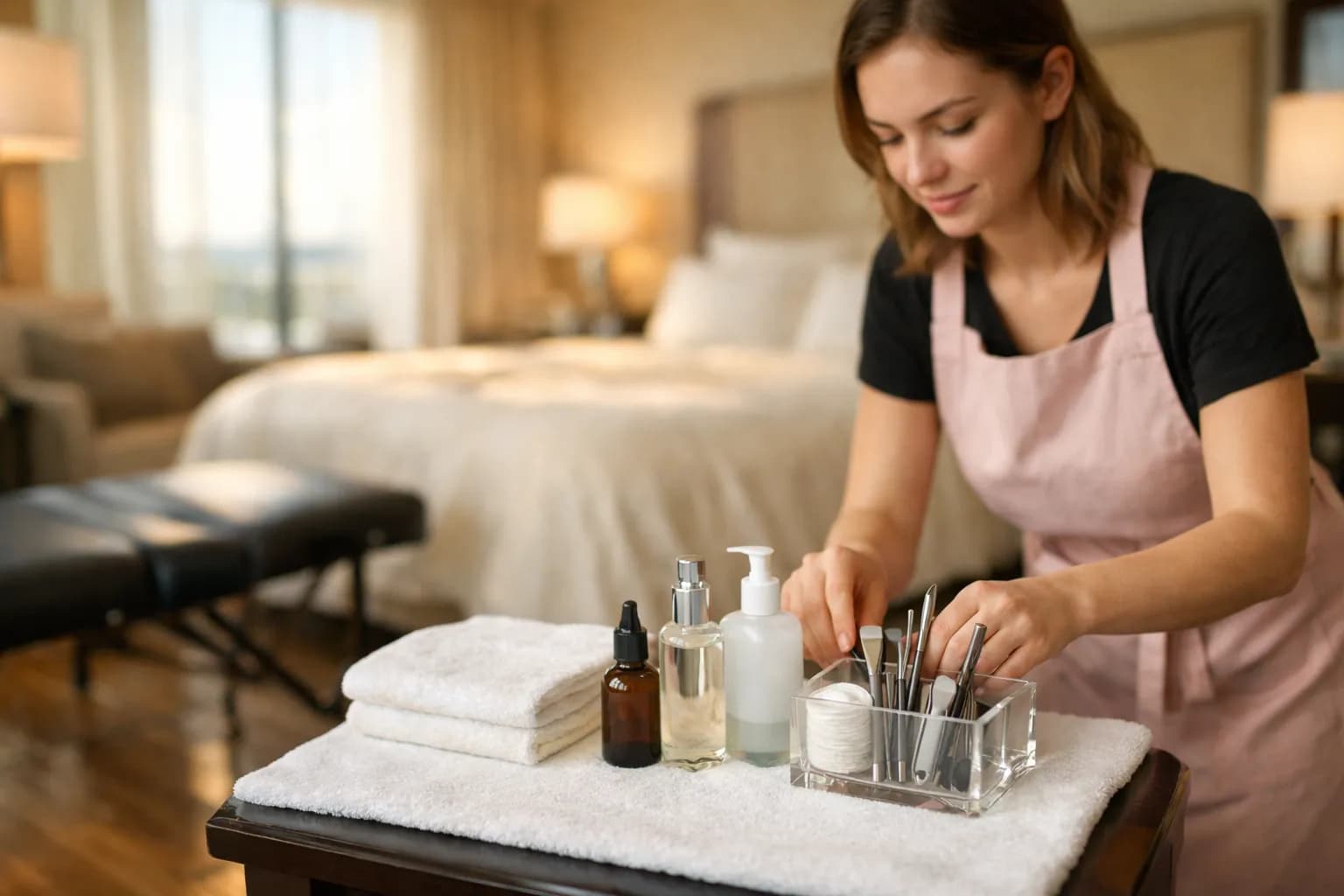
You also need to think through your setup. A portable massage table or facial bed, professional-grade LED lighting, a clean kit with properly sanitized tools, and a dedicated bag system for dirty versus clean implements all add up. The upfront cost is lower than building out a suite, but it is not zero.
For estheticians thinking through their business structure and what expenses to track, the add-a-specialty-beauty-license-florida post is worth reading alongside this one, especially if you are considering layering services to make a mobile menu more complete.
How to Build a Mobile Client Base Without Starting From Zero
The fastest path to mobile clients is through events. Bridal groups and corporate wellness days are booked in advance and involve multiple services, while bachelorette weekends in particular refer out constantly. One good bridal client who tells her friends is worth more than a dozen cold inquiries.
Some things that help early on:
- Get clear on your service menu and what you will and will not do on-location. Trying to offer everything mobile leads to a messy setup and unhappy clients.
- Set your travel radius and your travel fee before you talk to your first inquiry. Figuring it out on the spot leads to undercharging.
- Build a sanitation checklist that you run through at every on-location setup. It protects clients and protects your license.
- Know your licensing requirements cold. A client complaint about a sanitation issue or an unlicensed service is not just a one-star review. In Florida, it can trigger a DBPR complaint.
If you are still in the process of choosing which program to train in and mobile work is part of your vision, take a look at Pristine Beauty Academy's programs page to see which licenses open which doors.
FAQ
Can I legally do beauty services in clients' homes in Florida? It depends on the service and your license. Estheticians and lash specialists can often work in private settings, but must maintain Florida sanitation standards wherever they work. Nail services typically require a licensed salon location. Permanent makeup artists are regulated by the Florida Department of Health and face additional restrictions on where tattooing can be performed. Check with the relevant agency for your license type before booking off-site.
Do I need a separate license to work mobile in Florida? No separate "mobile license" exists in Florida. You need the same state-issued license you would need to work in a salon. What changes is your setup and your insurance. You also need to comply with Florida sanitation rules in an off-site environment.
What insurance do mobile beauty professionals need? At minimum, professional liability and general liability coverage. You need to confirm with your insurer that the policy covers you at client locations, not just a fixed business address. Many standard beauty professional policies require a rider for off-site work.
Is mobile beauty work profitable in Central Florida? It can be. The market supports it, especially for bridal and event work. Profitability depends on your service radius, your pricing (including travel fees), and keeping unbillable travel time under control. It is not passive income, but for licensed pros who manage their schedule well, it is a viable business model.