Next to The Florida Mall in Orlando
407-747-3124
Permanent Makeup Consults vs. Tattoo Consults
TL;DR: A permanent makeup consultation is not a shorter version of a tattoo consult. It covers facial symmetry and skin type in ways a traditional tattoo consult never needs to, and it also factors in pigment fading alongside the client's daily makeup habits. If you are training in PMU or planning to book a service, knowing what a thorough consult looks like is how you protect the result.
Walk into a tattoo studio and the consult is mostly about design and placement, with a focus on what the finished piece will look like healed. Walk into a permanent makeup appointment and you are dealing with a moving target. Facial features shift with age, and brows grow and get shaped differently every few months. On top of that, the pigment is going to fade over one to three years. The artist has to think about all of that before a single stroke lands on the skin.
For anyone considering the Permanent Makeup Artist program at Pristine Beauty Academy, understanding what a real consult covers is the first step toward understanding why PMU is its own discipline. And for clients who have never had the service, knowing what to expect in that chair makes the whole experience less intimidating.
The Skin Is the Canvas, and It Is Never Neutral
A traditional tattoo artist cares about skin condition, but mostly in the sense of making sure the area is healthy and not sunburned, and that it isn't scarred in a way that will distort the design. Permanent makeup artists take that several steps further because the face is not a flat, uniform surface.
During a PMU consult, the artist assesses:
- Skin tone and undertone, because the wrong pigment base can heave warm or ashy in ways that look off against the client's complexion
- Skin texture and oiliness, because oily skin breaks down pigment faster and may cause powder brows to look softer and less defined than they would on drier skin
- Previous PMU or cosmetic tattooing, because old pigment that has shifted warm or cool has to be factored into the new color choice
- Sun damage and visible capillaries near the treatment area, which affect how the skin holds pigment
None of that analysis happens in a standard tattoo consult because the ink used in body tattooing is formulated to be permanent and sits deeper in the dermis. The artist is choosing colors that will last decades. PMU pigments are designed to fade, and the rate of that fading is personal. Skin type is a variable. The consult is where you figure out which variable you are working with.
Facial Mapping and Symmetry Come Before Design
A tattoo consult often starts with the client's reference image. The client brings in something they love, the artist adapts it for placement on the body, and the conversation is mostly aesthetic. PMU works backward from the face itself.
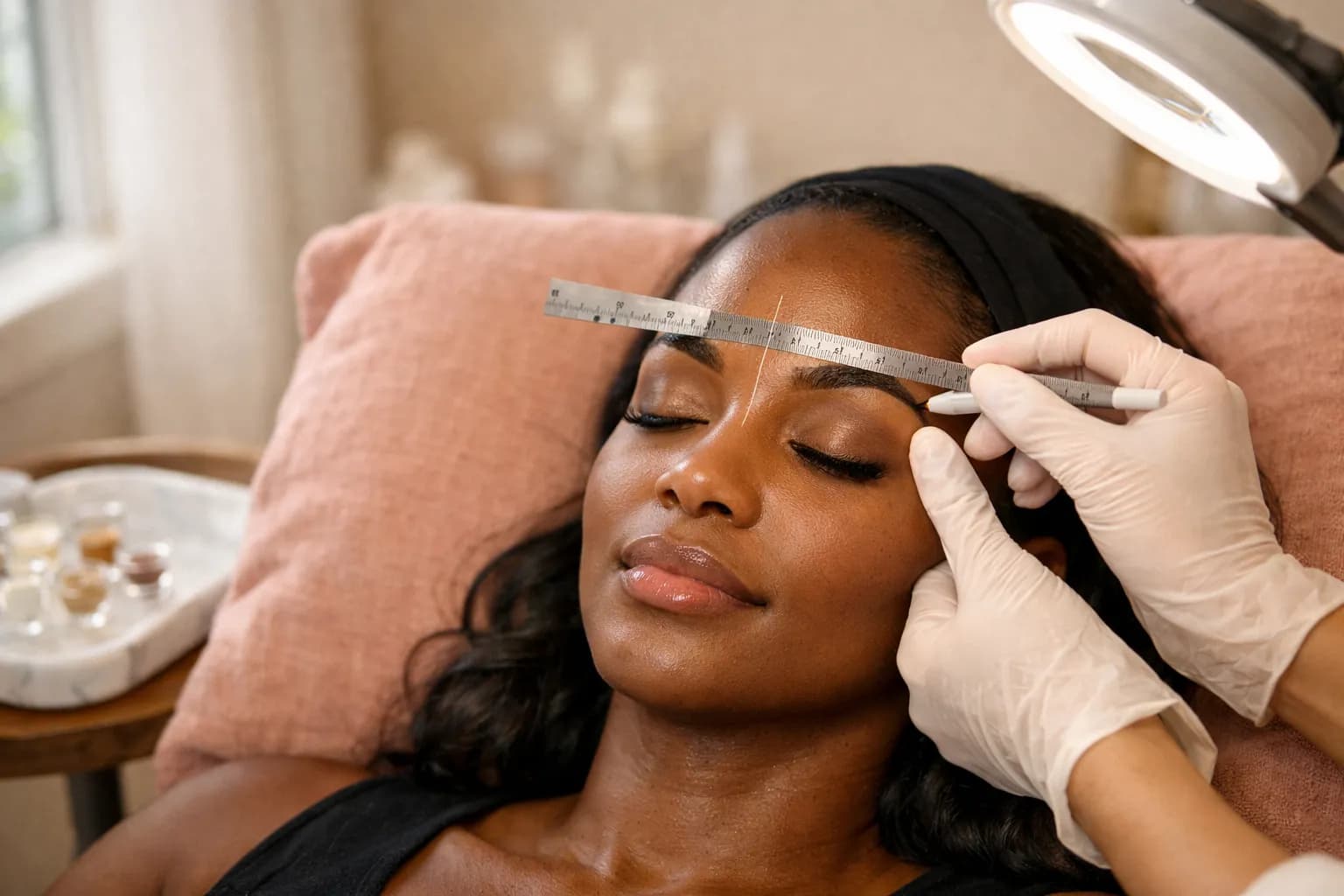
For brows, the artist uses facial mapping: measuring the distance between the eyes, identifying where the brow should start and arch based on bone structure, and figuring out how the client's natural brows relate to the shape being proposed. Most clients have asymmetrical brows to some degree. The consult is where that gets acknowledged and addressed before anyone commits to pigment.
For lips, the same idea applies. The artist looks at the client's natural lip line and the amount of pigmentation already there, then establishes whether the goal is definition or fullness, or whether color correction is the priority. For eyeliner, the eye shape drives the conversation. The artist considers what kind of lid space the client has, whether they wear contact lenses, and whether they want a result that looks like liner or something that just makes the lash line appear fuller.
This is facial architecture work. It is closer to what a makeup artist does in a film consult than what a tattoo artist does sketching a sleeve. The technical language overlaps (needle depth, pigment viscosity, aftercare), but the decision-making process is different.
The Lifestyle Questions Are More Specific
Both consults cover aftercare. A tattoo artist will tell you to keep the area clean and moisturized while it heals. A PMU artist does that too, but the lifestyle questions go further.
A thorough PMU consult asks about:
- Daily skincare routine, specifically whether the client uses retinoids or exfoliating acids near the brow or lip area, because those ingredients speed up fading significantly
- Sun exposure habits, since UV breaks down pigment faster on the face than on areas typically covered by clothing
- How the client fills in their brows or does their lips now, because that tells the artist what the client considers their "normal" and what they are actually trying to achieve with PMU
- Medical history relevant to the face and skin, including recent laser treatments, chemical peels, or any condition that affects healing
A client who does a glycolic peel every two weeks and spends most of their time outdoors is going to need a different conversation about realistic expectations than a client who uses a basic moisturizer and sunscreen. The consult is where you figure that out, not after the fact.
If you want to understand why demand for this kind of expertise keeps growing, the post on why permanent makeup was booming heading into 2025 lays out the client-side appetite for services that simplify a daily routine.
Florida's License Is a Tattoo License, Not an Esthetics License
This surprises a lot of people. In Florida, permanent makeup artists apply for a Tattoo Artist License through the Florida Department of Health. Not a facial specialist license. Not anything issued by the Florida DBPR (Department of Business and Professional Regulation). The Department of Health.
That has real implications for what happens in a consult. A PMU artist is operating under the regulatory framework of tattooing, which means the same health and safety standards around bloodborne pathogens apply. This includes requirements for single-use needles and proper sterilization. The consult should reflect that. A client intake form for PMU should cover contraindications (blood thinners, keloid history, pregnancy, autoimmune conditions) in the same level of detail that a tattoo studio intake form would, because the legal exposure is the same.
You do not need to hold a separate esthetics license to do permanent makeup in Florida. The tattoo license stands on its own. But knowing the skin and how it heals, and understanding how pigment interacts with different skin types, is what separates an artist who gets consistently good results from one who does not.
If you want a broader picture of how PMU training and licensing work compared to microblading and powder brow demand, that comparison is worth reading before you commit to a program.
What a Well-Run PMU Consult Actually Looks Like
Putting it together, here is what a client should expect and what a trained PMU artist should be doing in that first appointment:
- Intake form review covering medical history, current skincare, medications, and previous cosmetic procedures
- Skin assessment in good lighting, looking at tone, texture, oiliness, and any existing pigment
- Facial mapping with measurements, done before any design goes on the skin
- A clear conversation about the proposed shape and color, including what the pigment will look like as it heals and fades
- Patch test discussion (some artists do this at the consult, some require it before booking)
- Honest expectation-setting about touch-ups: most PMU work requires one follow-up appointment four to six weeks after the first session, and annual or biannual color refreshes after that
A client who leaves a PMU consult without understanding the touch-up schedule is a client who is going to be unhappy in six months. Getting that conversation right is as important as getting the shape right.
Frequently Asked Questions
Does a permanent makeup consultation take longer than a tattoo consult? Often, yes. Because PMU involves detailed facial mapping, skin assessment, and in-depth lifestyle questions, a thorough consult can run 30 to 60 minutes before any service begins. A traditional tattoo consult can be much shorter if the design is straightforward.
Do I need a patch test before a permanent makeup appointment? Many artists require one, especially for clients with sensitive skin or a history of allergic reactions. A patch test places a small amount of pigment in an inconspicuous area and gives you 24 to 48 hours to check for a reaction. Some artists do it at the consult, while others schedule it as a separate step. Ask about the policy when you book.
What license does a permanent makeup artist need in Florida? In Florida, permanent makeup artists apply for a Tattoo Artist License through the Florida Department of Health. This is separate from any esthetics or nail license issued by the Florida DBPR (Department of Business and Professional Regulation). You do not need a facial specialist license to practice PMU in Florida.
What skin types hold permanent makeup pigment the longest? Drier, less oily skin tends to hold pigment longer. Oily skin metabolizes pigment more quickly, which means clients with oily skin may need touch-ups more often. Sun exposure and use of exfoliating skincare ingredients also accelerate fading regardless of skin type.