Next to The Florida Mall in Orlando
407-747-3124
Do You Know What Lash Lifts and Extensions Really Demand?
TL;DR: A lash lift works with the client's own lashes using a chemical process, while lash extensions add individual synthetic fibers one by one using adhesive. Both require precision and a steady hand, but they ask for different training and different product knowledge, and in Florida, they sit under the same license.
If you're exploring the lash world as a career path, the conversation usually starts with the client side: which one looks better, which one lasts longer, which one is worth the money. That's fair. But once you're behind the bed, the questions shift entirely. Now you're asking which one is harder to execute, which one has more room for error, and which one is going to build your clientele faster.
Those are the questions worth answering before you invest in training. Here's how both services actually work, what each one demands from you as a technician, and where they overlap.
What a Lash Lift Actually Involves
A lash lift is a chemical curl treatment applied to the client's own natural lashes. The goal is to lift the lash from the base so it appears longer, more open, and curled without adding anything to it. It's often paired with a lash tint, which deposits color directly on the lash shaft.
The process, broken down:
- Cleanse the lashes thoroughly to remove any trace of oil or makeup.
- Apply a silicone rod or shield to the lid, sized to match the curl result the client wants.
- Adhere the natural lashes to the rod using a water-soluble glue, combing each lash flat against the shield with no crossing or clumping.
- Apply the lifting solution, which breaks the bonds in the lash structure so it can take a new shape. Timing here is everything.
- Neutralize with a setting solution that locks the new curl in place.
- Remove the rod and clean the lashes. If a tint is added, it goes on now.
What this service actually demands from you is precise timing and clean application technique. The lifting solution can over-process if left too long, leaving the lashes frizzy or outright damaged, crimping is often the first sign something has gone wrong. Under-process it and the curl drops within days. You're reading the client's natural lash texture and growth cycle, while also factoring in the thickness of each individual lash, to decide how long that solution sits. That judgment call is learned, not guessed.
The rod placement itself requires patience. Getting each lash flat against the shield with no overlap, working across the full lash line without disturbing what's already placed, is fiddly work. Clients who come in with short or sparse lashes make this harder, as do lashes that grow at an angle.
Results typically last six to eight weeks, following the client's own lash cycle. No fills needed. That low maintenance cycle is part of the service's appeal for clients, and it also means your skill has to hold up for the full duration.
What Lash Extensions Actually Involve
Lash extensions add individual synthetic fibers (or fans, in volume work) to each natural lash using a semi-permanent adhesive. The result is longer, fuller lashes that the client wakes up with every day.
The process, broken down:
- Cleanse and prime the lashes to remove all oil and residue. Adhesive does not bond well to oil.
- Apply under-eye gel pads to protect the lower lashes.
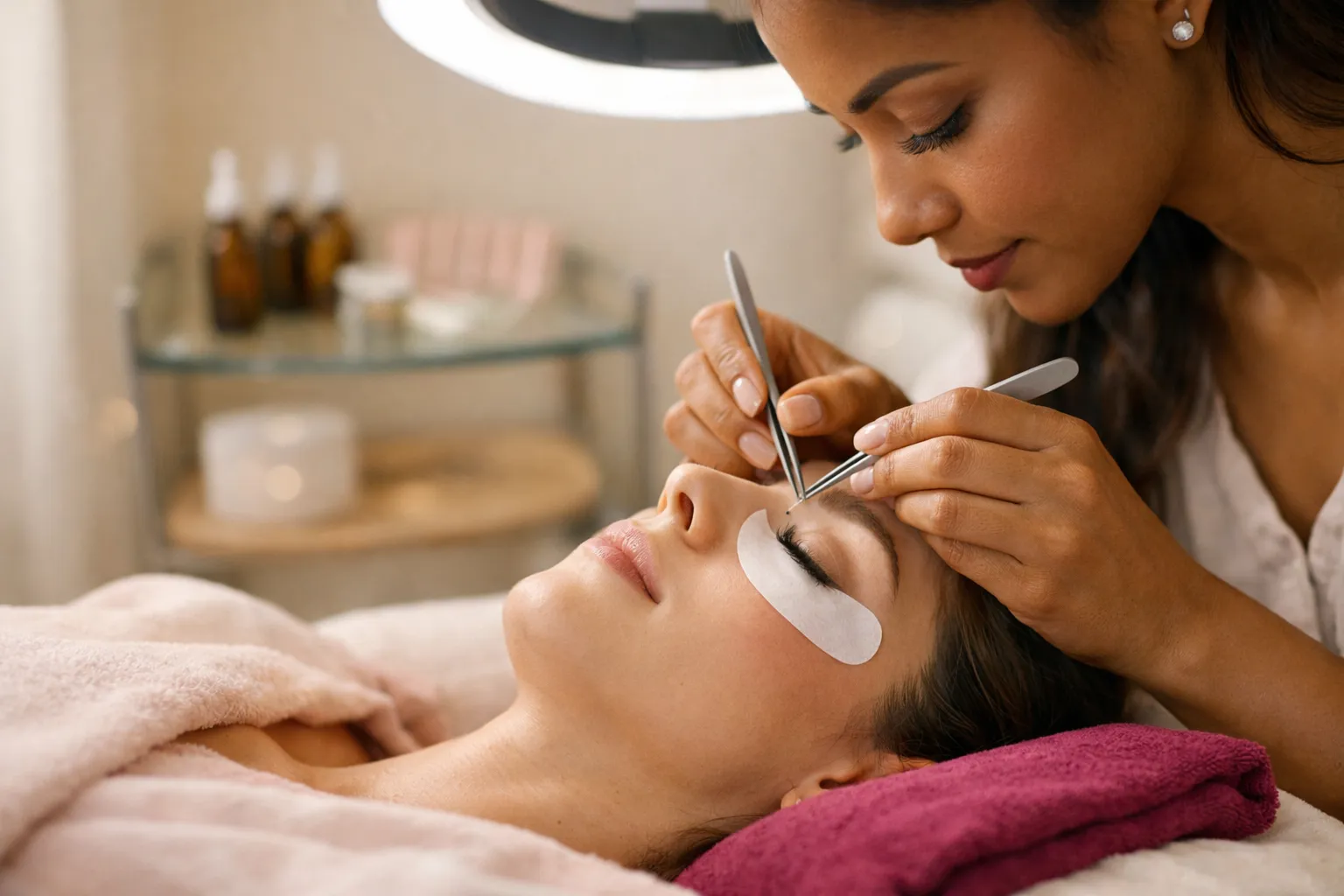
- Using isolation tweezers in one hand, isolate a single natural lash from the rest of the lash line.
- Using application tweezers in the other hand, pick up a pre-made extension or hand-fan a volume fan, dip it lightly in adhesive, and place it on the isolated natural lash approximately 1mm from the skin.
- Hold for a moment, release, and move to the next lash.
- Repeat across the full lash line, following the natural growth pattern to create the agreed-upon map.
A full classic set can take two hours or more. Volume sets take longer. The work is meticulous and repetitive: your posture and lighting matter, and so do your tweezers. Poor isolation means extensions bonding to two lashes instead of one, which pulls as the lashes grow at different rates and can damage them. Adhesive pooling at the base causes the same problem.
You're also having a design conversation with every client before you start. Lash mapping means choosing the curl, length, diameter, and placement to suit the client's eye shape and their lifestyle. Someone who sleeps face-down and works out daily needs a different map than someone who treats their lashes like porcelain. That consultation skill is as important as the application itself. The post on classic versus volume lash extensions goes deeper on how those mapping decisions change the result.
Fills every two to three weeks keep the set looking fresh as natural lashes shed. That fill cycle is what builds a loyal, returning clientele.
Where the Two Services Differ Most
The biggest practical difference between the two is the type of precision each one demands.
A lash lift is chemical precision: you're managing solution timing and moisture levels while also controlling product saturation on a living hair fiber. The variables are largely about chemistry and reading the lash condition in front of you.
Lash extensions are mechanical precision: you're placing an individual object on another individual object, repeatedly, for two hours, without letting your tweezers touch the skin or glue two lashes together. The variables come down to hand control and isolation on one side, and adhesive management on the other.
Adhesive for extensions is humidity and temperature sensitive. Too dry and it cures before the extension is placed. Too humid and it cures too fast and doesn't bond cleanly. You learn to control your room environment, not just your technique.
There's also a client commitment difference worth understanding. A lash lift client comes back every six to eight weeks, or not at all if they want a break. A lash extension client is on a consistent fill schedule, and skipping fills means the set looks patchy. Extensions build a more predictable repeat-booking calendar. Lifts attract clients who want lower maintenance.
The Florida License Question
Both services fall under the Florida facial/skincare specialist license (also called a facial specialist license). In Florida, lash extensions are a licensed esthetic service, not a standalone certification anyone can offer without a license.
A lash tint, which often accompanies a lift, is also a licensed service in Florida because it uses a chemical on the face near the eyes.
The Certified Eyelash Extension add-on program at Pristine Beauty Academy is designed for students who already hold or are completing their facial specialist training. It layers extension-specific technique onto the foundational knowledge the full program builds. If you're already licensed as a facial specialist and want to add this skill, adding a specialty is a path worth looking at.
Before any chemical service near the eyes, patch testing is non-negotiable. The post on why patch testing matters before a lash service covers exactly why that step protects both the client and your license.
Which One Should You Learn First
If you're building a lash menu from the ground up, extensions tend to come first in training because they build the foundational skills that transfer everywhere: isolation, adhesive control, lash mapping, and client consultation. Lifts layer on top of that with chemical knowledge that also connects to other skin treatments.
That said, some technicians lead with lifts because they're faster to execute, require less equipment investment, and are easier to explain to a client who's never had a lash service before. The growth in demand for lash services overall makes a strong case for learning both and offering them as a menu, not an either-or.
The most useful thing you can know going in: neither service is a beginner service just because it looks simpler from the outside. Both require clean technique and real product knowledge, and you'll need substantial practice on live models before you're offering them to paying clients.
Frequently Asked Questions
Can a lash lift and lash extensions be done at the same time? No. A lash lift processes the natural lash with a chemical solution. Applying extensions immediately after would mean placing adhesive on a chemically treated, potentially fragile lash. Most technicians recommend waiting at least six weeks between a lift and a fresh set of extensions.
Does Florida require a specific license to perform lash lifts? Yes. In Florida, a lash lift is performed under the facial/skincare specialist license, issued by the Florida DBPR (Department of Business and Professional Regulation). It is not a service that can be offered without a state license.
How long does it take to get good at lash extensions? Most technicians spend several months of consistent practice on models before their speed and isolation quality reach a professional standard. Training gives you the foundation. The hours you put in after training build the confidence and consistency clients can feel.
Are the tools different for a lift versus extensions? Yes. A lift uses silicone rods or shields, adhesive for rod placement, and two chemical solutions: a lifting solution and a setting solution. Extensions require two types of tweezers (isolation and application), extension fibers in various curls and lengths, adhesive formulated for extension bonding, and primer. The investment in extension supplies is generally higher. Adhesive storage and replacement are ongoing costs to plan for, adding to the difference.